
Difference Between Certificate and Diploma: Which Is Better?
ASSESS YOUR SKILLS NOW - FREE!!Choosing the right qualification can have a major impact on your career. In Australia, students can choose from certificates, diplomas, and other nationally recognised training options. Understanding the difference between certificate and diploma can help you decide which qualification is better suited to your skills, career plans, and study goals.
Both options can provide valuable knowledge and improve your employment opportunities. However, they differ in study level, course content, duration, and potential career outcomes. Before choosing between the two, it is important to understand what each qualification offers.
What Is a Certificate?
A certificate is generally designed to provide practical skills and knowledge for a particular occupation or industry. In Australia, certificates are available at different levels under the Australian Qualifications Framework (AQF) including Certificate I, II, III, and IV.
Certificate courses are common in industries such as construction, electrical work, hospitality, healthcare, community services, disability support, and hairdressing.
For example, students may complete qualifications such as Certificate III in Electrotechnology Electrician , Certificate III in Hairdressing , or Certificate IV in Disability Support.
A certificate can be a suitable choice if you want practical training that prepares you for employment or helps you develop skills for your current job.
What Is a Diploma?
A diploma generally provides broader and more advanced knowledge than certificate-level qualifications. It can prepare students for technical, professional, supervisory, or management positions, depending on the industry.
Diplomas are available across many areas, including business, hospitality, community services, information technology, healthcare, and management.
A diploma may be suitable for someone who already has industry experience and wants to move into a higher-level role. It can also provide a pathway to further education, depending on the course and institution.
Difference Between Certificate and Diploma
The difference between the two becomes clearer when you look at the level and depth of learning involved.
Certificates generally focus on practical and occupation-specific skills. Diplomas often provide broader knowledge and may include more advanced responsibilities such as planning, leadership, problem-solving, and management.
Some key differences include:
- Certificates are often more focused on practical workplace skills.
- Diplomas generally cover broader and more advanced concepts.
- Certificates may take less time to complete.
- Diplomas can require a longer period of study.
- Certificates can prepare students for skilled or support roles.
- Diplomas may support technical, professional, supervisory, or management careers.
However, the exact outcomes depend on the qualification and industry.
Diploma vs Certificate: Which Takes Longer?
When comparing diploma vs certificate, course duration is an important factor. There is no single timeframe because every qualification has different requirements.
Some certificates can be completed within several months, while others may take one to two years. Diploma courses can also vary, with many taking one to two years or longer depending on the training provider and study method.
Your previous education and work experience may also affect the duration. Recognition of Prior Learning (RPL) can sometimes reduce the amount of training required for experienced workers.

Certificate and Diploma: Which Has Better Career Value?
There is no qualification that is automatically better for every student. The certificate and diploma pathways are designed for different career and learning needs.
A certificate may be enough if your chosen occupation requires a practical qualification. For example, many trade and support roles have specific certificate-level qualifications that are recognised by employers.
A diploma may be more suitable if your career goal involves management, advanced technical responsibilities, or a higher level of professional knowledge.
Therefore, the difference between certificate and diploma should be considered in relation to your specific career goals rather than simply choosing the qualification with the higher level.
Certificate or Diploma: Which Should You Choose?
When deciding between a certificate or diploma, start by looking at the requirements of the career you want to pursue.
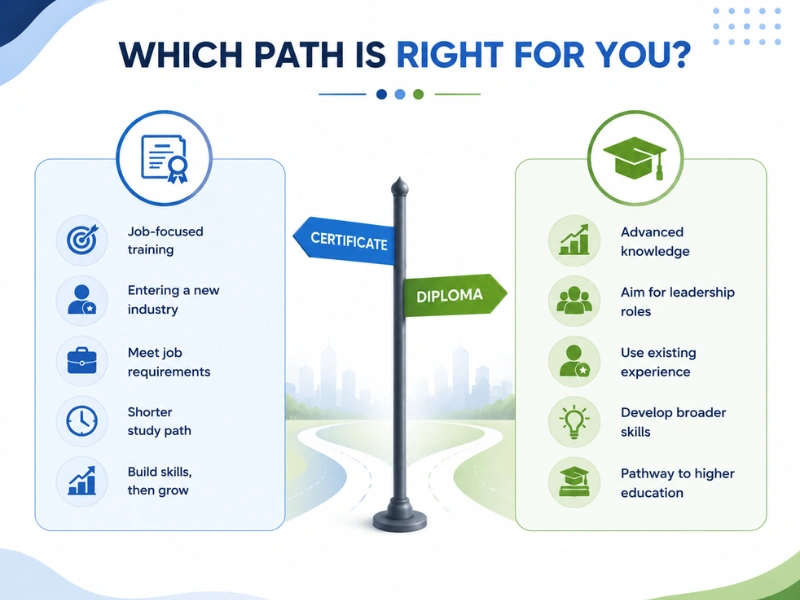
A certificate may be suitable if you:
- Want practical, job-focused training.
- Are entering a new industry.
- Need a qualification for a particular occupation.
- Prefer a shorter study pathway.
- Want to develop skills before progressing to further education.
A diploma may be a better choice if you:
- Want more advanced knowledge.
- Are aiming for supervisory or management roles.
- Already have relevant industry experience.
- Want to develop broader professional skills.
- Plan to continue into higher education.
The right decision depends on your existing skills, career objectives, and the qualification required by your preferred industry.
Can You Progress From a Certificate to a Diploma?
In many cases, yes. Students can often progress from a certificate to a diploma when they want to develop more advanced knowledge and skills.
The exact pathway depends on the qualification and training provider. Some providers may recognise previous study and give you credit for completed units.
This means choosing a certificate or diploma does not always have to be a permanent decision. Your education can develop alongside your career and changing professional goals.
Recognition of Prior Learning for Experienced Workers
If you already have significant industry experience, Recognition of Prior Learning (RPL) may help you gain formal recognition for skills you have developed through employment.
RPL involves assessing your existing knowledge and experience against the requirements of a qualification. You may need to provide documents such as employment references, resumes, work samples, previous training records, or other evidence.
Eligible workers may be able to use RPL to gain either a certificate or diploma without repeating training for skills they already demonstrate.
Difference Between Certificate and Diploma for Career Progression
The difference between certificate and diploma can also be important when planning long-term career growth.
A certificate may help you enter an industry, develop specific workplace skills, or meet an employment requirement. A diploma may help you move towards more senior responsibilities, depending on the industry and occupation.
For example, someone working in hospitality may begin with practical training and later pursue a management-level qualification. Similarly, a community services worker may continue studying to move into coordination or leadership roles.
Before enrolling, always check the qualification requirements for the position you want.
Diploma vs Certificate: Understanding RPL Options
The diploma vs certificate decision can also depend on your existing experience. If you have worked in an industry for several years, RPL may allow you to have your skills assessed against the requirements of your chosen qualification.
This can be useful for workers who have gained knowledge through employment but have never completed formal training.
Pentagon Consultancy can help experienced workers understand RPL eligibility, prepare evidence, and identify suitable registered training providers.
How Pentagon Consultancy Can Help
Choosing a qualification can sometimes feel confusing, especially when you are unsure about entry requirements, course duration, or RPL options.
Pentagon Consultancy provides guidance to students and experienced workers looking for suitable training pathways. Our support can include:
- Qualification pathway guidance
- Eligibility assessments
- RPL guidance
- Evidence preparation
- Training provider selection
- Application assistance
- Physical fitness
- Time management
- Course pathway advice
Whether you are considering a certificate or a diploma, our team can help you understand your options and make an informed decision.
Final Thoughts
Understanding the difference between certificate and diploma is an important step when planning your education and career. Certificates generally focus on practical and job-specific skills, while diplomas often provide broader and more advanced knowledge.
The best choice depends on your career goals, industry requirements, previous experience, and preferred learning pathway. You should always check the requirements of your chosen occupation before enrolling.
If you already have relevant workplace experience, RPL may also provide a useful pathway to formalise your existing skills. With the right qualification and guidance, you can build skills that support your current career and future opportunities.
FAQs
Most frequent questions and answers